
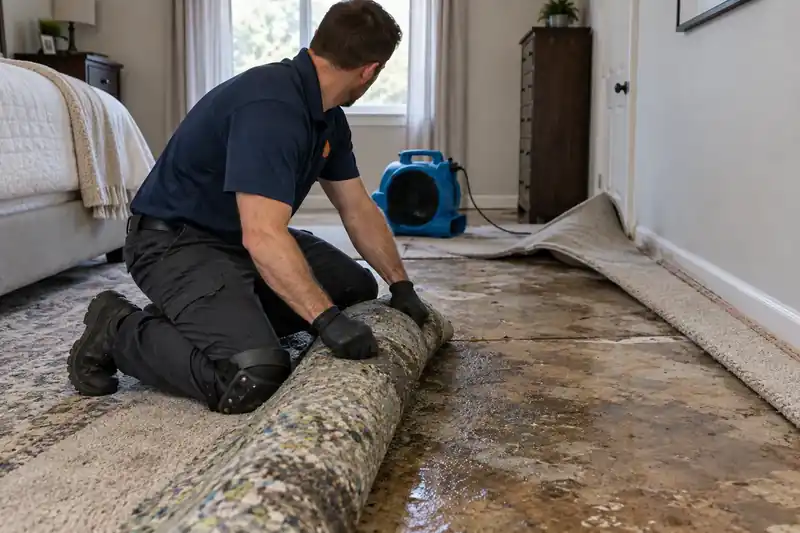
Flooded Carpet Water Extraction in DeSoto, TX
If your carpet squishes underfoot, most of the water is in the pad below it and on the concrete slab underneath. Stop the source, get furniture off the wet area, then call. Our crew can press the water out of carpet and pad, decide what can be saved, and dry the floor down to the slab.
226 Google, Yelp & Facebook reviews · Est. 2019
Request water extraction
Send your details and our team will contact you.
Water spreading now? Call (972) 961-2225
What is flooded carpet water extraction?
Flooded carpet water extraction is the removal of water from a carpeted floor after a leak, overflow or flood. It treats the floor as layers, because each one holds water differently. The carpet on top holds some water. The foam pad below holds much more, and the concrete slab under the pad absorbs moisture and releases it slowly.
Around the edge of the room sits the tack strip, a thin wood strip with angled pins that grips the carpet. It soaks up water along the walls, right where baseboards and drywall meet the floor.
The goal is to get enough water out of every layer that the carpet can be dried or, when it cannot be saved, removed before the problem spreads into walls and the rooms next door.
How does flooded carpet extraction work?
Extraction is only as good as the water it pulls from the pad. Surface water is easy. The pad is where the real volume sits, and our method depends on how much water there is and what kind.
- Weighted extraction. Our technician stands on or rides a weighted tool connected to a truck-mounted or portable vacuum. The weight compresses carpet and pad together so water is squeezed out of both and pulled away.
- Repeated passes. Slow, overlapping passes go until little or no water comes up the hose. A quick pass with a wand leaves the pad wet.
- Floating the carpet. When the pad is saturated, the carpet is lifted off the tack strip, the pad is cut out, and air movers blow air under the carpet so it dries from both sides.
- Drying the slab. Once the pad is gone, the bare concrete is dried with air movers and dehumidifiers and checked with a moisture meter.
- Re-stretching. After everything reads dry, new pad goes down and the carpet is stretched back onto the tack strip.
Drying the carpet is only part of the job. Wet baseboards and the bottom of the drywall behind them usually need structural drying too, or moisture stays trapped behind the walls.
What are the warning signs of wet carpet and pad?
Carpet hides water well. A floor can look normal while the pad underneath is soaked. These signs point to trapped water:
- Carpet that squishes, or leaves a wet footprint when you step on it
- Patches that look darker than the rest of the floor
- Spots that feel cold or clammy through socks, even when they look dry
- A musty or sour smell that gets stronger near the floor
- Brown or yellow stains appearing on the surface as the carpet dries
- Ripples, bubbles or loose areas that were flat before
- Baseboards swelling, or paint peeling at the bottom of the wall
- Rust or wood-colored stains around the legs of furniture
Two or more of these together usually means the pad is wet, even if the carpet surface has dried.
What floods carpet in DeSoto homes?
Most DeSoto homes are brick houses on concrete slabs, built from the 1970s through the 2000s, and many still have wall-to-wall carpet in bedrooms and living areas. On a slab, carpet and pad sit directly on concrete, so water has no crawlspace to drain into. It spreads sideways under the carpet and soaks into the tack strip along every wall it reaches.
The most common sources are inside the house:
- Supply lines. A split pipe or failed fitting, especially after a hard freeze like February 2021, can soak several carpeted rooms at once.
- Appliances. A leaking water heater in an interior closet, a burst washing machine hose or an overflowing AC drain pan often wets the carpet in the next room first.
- Toilets and tubs. An overflow from a bathroom runs under the door and into bedroom carpet.
- Storm water. Heavy spring rain forced under a patio door wets carpet with outside water, which is treated as contaminated.

What can you safely check first?
Before our crew arrives, a few careful steps limit the damage and help the carpet's chances.
- Stop the source. Close the fixture's valve or the main valve.
- Find the edge. Press a dry white towel on the carpet, moving outward, until it stops picking up water. That line shows how far the water went.
- Identify the water. Clean supply-line water, gray appliance water and sewage or outside water are handled differently.
- Get things off the floor. Move rugs, electronics, papers and fabric items. Put foil or plastic blocks under legs of furniture you cannot move.
- Keep foot traffic off. Walking on wet carpet pushes water deeper and spreads it.
WarningDo not pull up wet carpet yourself. The tack strip pins are sharp, soaked carpet is very heavy, and carpet that is torn or overstretched while wet often cannot be reinstalled. If the water came from a toilet backup or from outside, do not touch the carpet at all.
What happens during our visit?
A carpet extraction visit follows a clear order so nothing wet gets missed.
- Source and category. Our crew confirms the water is stopped and identifies whether it was clean, gray or black water.
- Moisture check. A meter maps how far the water spread under the carpet, including into closets, hallways and the rooms next door.
- Furniture moved. Contents are moved off the wet area or blocked up so the floor can be worked.
- Extraction. Weighted extraction pulls water from carpet and pad, pass after pass.
- Save or remove. We explain whether the carpet and pad can be dried in place, floated, or have to be cut out and removed.
- Drying setup. Air movers go under or across the carpet, with dehumidifiers to pull the moisture out of the room.
- Final readings. Carpet, pad or bare slab, baseboards and lower walls are checked until they read dry.
What affects the cost of carpet water extraction?
We inspect before quoting. These factors change the scope on a flooded carpet job:
| Factor | Why it matters on wet carpet |
|---|---|
| Water category | Clean water may allow drying in place. Gray or black water means pad removal and often carpet removal too. |
| Square footage | More carpeted area means more extraction passes and more drying equipment. |
| Dry in place, float or remove | Floating carpet and replacing pad takes more labor than drying in place. Full removal adds disposal. |
| How long it sat | Carpet wet for days is more likely to delaminate, smell or grow mold, which rules out saving it. |
| Furniture and contents | Beds, dressers and sectionals must be moved or blocked up before extraction starts. |
When is flooded carpet an emergency?
Treat it as an emergency when the water came from a toilet, sewer line or outside, when more than one room is wet, or when water has reached the walls. It is also urgent if the carpet has been wet for more than a day, since the EPA notes mold can begin growing within 24 to 48 hours. Carpet caught early is far more likely to be saved.
Pro tipIf any carpet or pad has to be removed, ask our crew to keep a small cut square of each and photograph the label on the back. Your adjuster may want to see the type and quality of carpet you had.
Frequently asked questions
Does the carpet pad always have to be replaced?
Not always, but often. Pad is a foam sponge that holds far more water than the carpet above it, and it is slow to dry against a concrete slab. Pad soaked by gray or black water is always removed. Pad wet with clean water may be dried if extraction starts quickly, but we often replace it because it costs little compared with the carpet.
Can wet carpet be dried without pulling it up?
Sometimes. When clean water is caught early, weighted extraction and air movers can dry carpet and pad in place. When the pad is saturated or the water sat longer, our crew usually lifts the carpet off the tack strip, removes the pad and blows air underneath before laying it back.
What is carpet delamination?
Most carpet has two backings glued together with latex. When carpet stays wet too long, the glue lets go and the backings separate. The carpet then ripples, bubbles and will not stay stretched, and a delaminated carpet usually has to be replaced.
Will my carpet ripple or shrink after it gets wet?
It can. Wet carpet often loosens and wrinkles, and some backings shrink slightly as they dry. After drying, carpet that was lifted or loosened is re-stretched onto the tack strip and seams are checked, which takes care of most ripples.
Is a rental carpet shampooer enough to remove the water?
No. A rental shampooer is built to rinse the top of the carpet, not to pull gallons of water out of the pad and off the slab. It leaves the pad wet, and that is where odor and mold start. Use it for spills, not for flooding.
When can I put furniture back on the carpet?
Only after our readings show the carpet, pad and slab are dry. Carpet can feel dry on top while the pad underneath is still wet. Putting heavy furniture back too early traps moisture and can leave rust or wood stain marks from the legs.
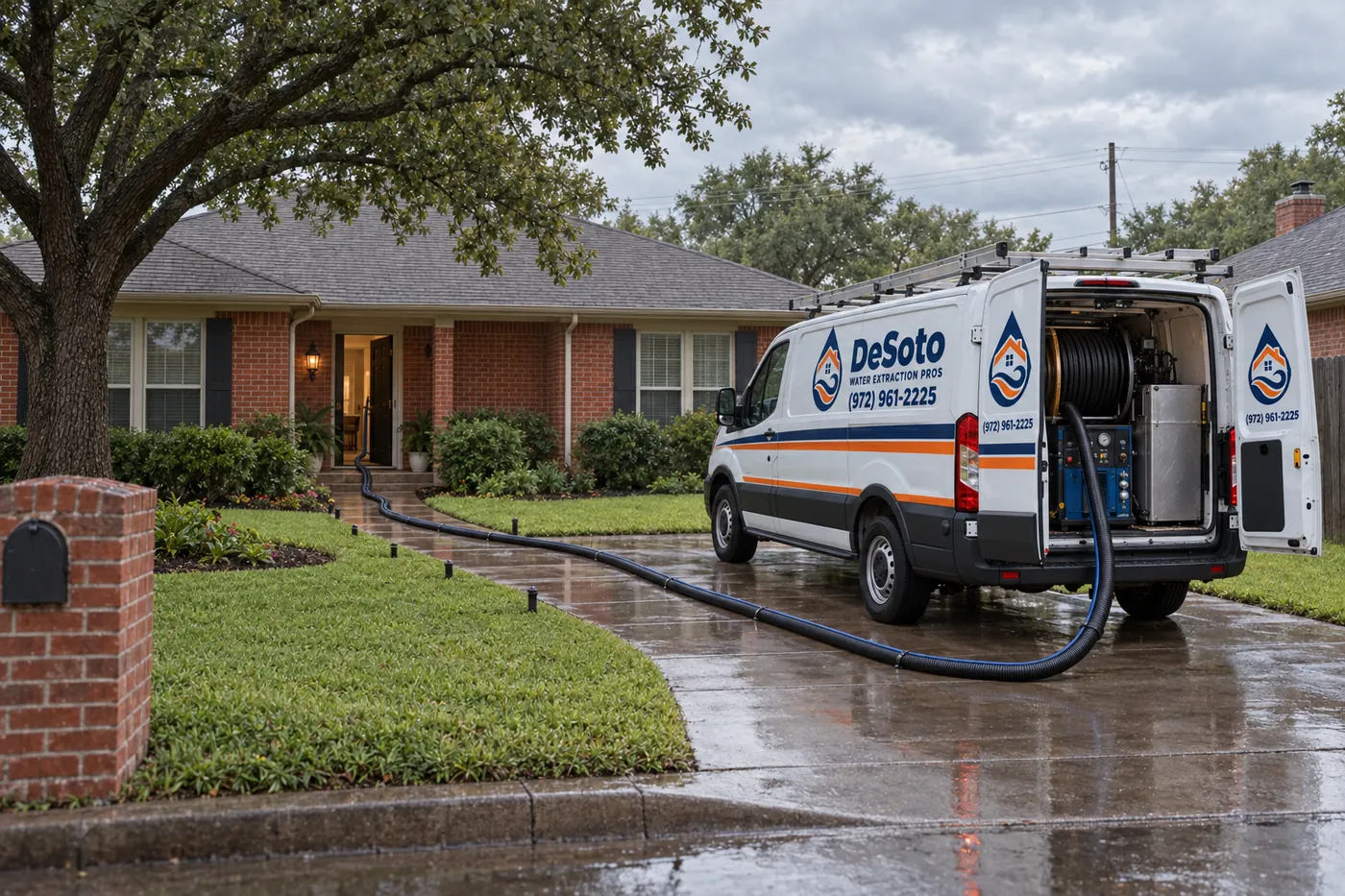
What Your Neighbors Are Saying About Us
Get the water out of the pad today
The longer carpet and pad stay wet, the less of it can be saved. Call us for flooded carpet extraction in DeSoto and nearby cities.
DeSoto Water Extraction Pros · 1603 Osprey Dr #107, DeSoto, TX 75115